Bjarke Ingels: The Pragmatic Visionary — Architecture for a Sustainable and Playful Future
If modernism sought intersection between function and postmodernism, Bjarke Ingels stands on his own ground, a pragmatic utopian who believes architecture can inspire and solve problems. Through his bold and innovative designs that consistently draw praise and criticism, Ingles has redefined architecture in the 21st century, merging technology and humor into the expansive field.
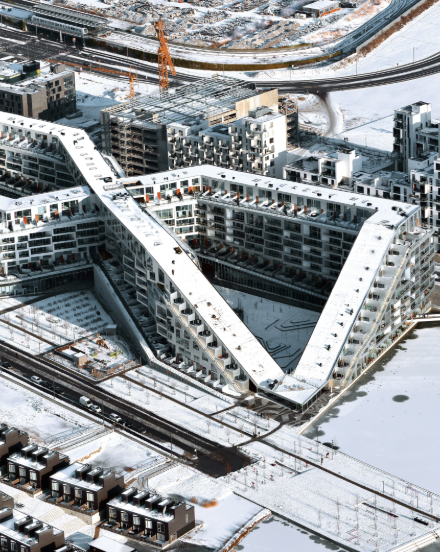
From his innovative ski slopes of CopenHIll, and twisting courtyards of 8 House, Ingles' buildings seem like they are part of a fantastical sci-fi world, one filled with optimism. His work and design, seems simple, yet poses his key question and approach: What if the future could actually be fun?
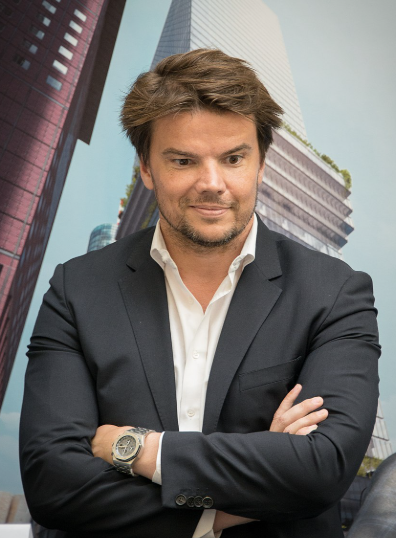
From Copenhagen to the World: A New Generation of Modernist
Born in 1974 in Copenhagen, Ingels grew up amid the shift in Danish design culture and political climate. He later studied architecture at the Royal Danish Academy of Fine Arts, and later at the Escola Técnica Superior d’Arquitectura in Barcelona, which shaped his playful style of architecture with Gaudi’s modernism and geometry in design. Ingels then joined Rem Koolhaas’s Office for Metropolitan Architecture (OMA) in Rotterdam, something that impacted him profoundly. During his tenure, he was fascinated with Koolhaas's programmatic complexity and analyzing and reflecting contradictions through architecture, something he took with him when setting up his own practice. However, rather than lean towards Koolhaas’s ironic critique symbolism in architecture, Ingels turned to playful optimism. He wanted to show that architecture could be useful yet utopian at the same time, thus he established his own firm, BiG(Bjarke Ingels Group). His ambition was not to reject modernism but to upgrade it — to make it playful, inclusive, and sustainable.
Design Philosophy: Pragmatic Utopianism
1. Yes Is More
His manifesto, captured in his 2009 graphic novel Yes Is More, reframed his vision of the architect, from Koolhaas’s critic style to a playful creator. Rather than rejecting globalization trends and the acceleration of technology in architecture, Ingels proposed to ‘hack’ the trend to create a positive impact.
“Architecture should not just reflect the conditions of modern life — it should improve them,” he writes.
By following this philosophy, he seeks to add more to traditional norms of design like art vs engineering, form vs function. He designs buildings that seem to connect things that don’t belong together, a powerplant and a ski slope, apartment and a street at the same time, expanding the limits of ‘acceptable’ designs.
2. Hedonistic Sustainability
For Ingels, sustainability is a special element towards his design, he even calls it ‘hedonistic sustainability’, a belief that he sees as enhancing the quality of life in his designs rather than restricting it with materiality usage.
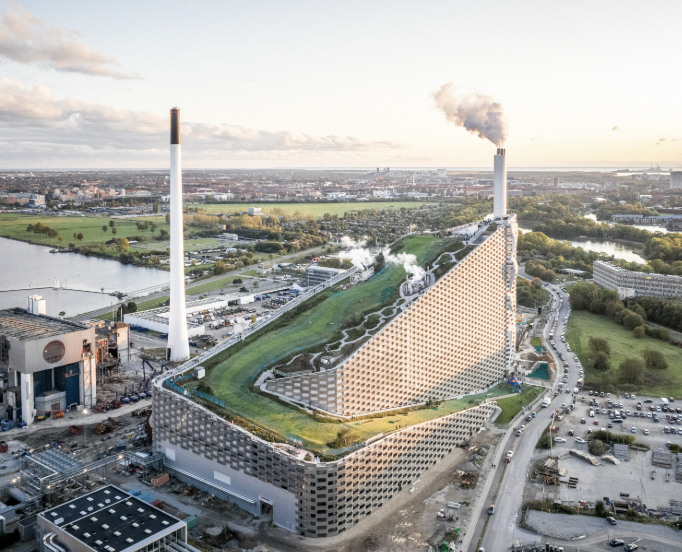
Rather than use traditional means of sustainability, he adopts the approach Yes is More. This can be best seen through his Amager Bakke (CopenHill) project in Copenhagen, where rather than waste space with the roof, he converted it into a makeshift ski ground, with hiking trails and a climbing wall. Adding to the playfulness of the design, he puffed smoke rings into the sky from the chimney, and created a system where carbon output can be measured. In this sense, he approached it with Yes Is More, turning sustainability into public use, turning architecture into a literal playground.
3. Architecture as BIGamy: The Union of Opposites
A common theme in his work is combining contradiction, something he calls “BIGammy”, questioning the boundary of design by combining elements that seem incompatible.
8 House (Copenhagen) merges housing, offices, and communal streets into one continuous loop.
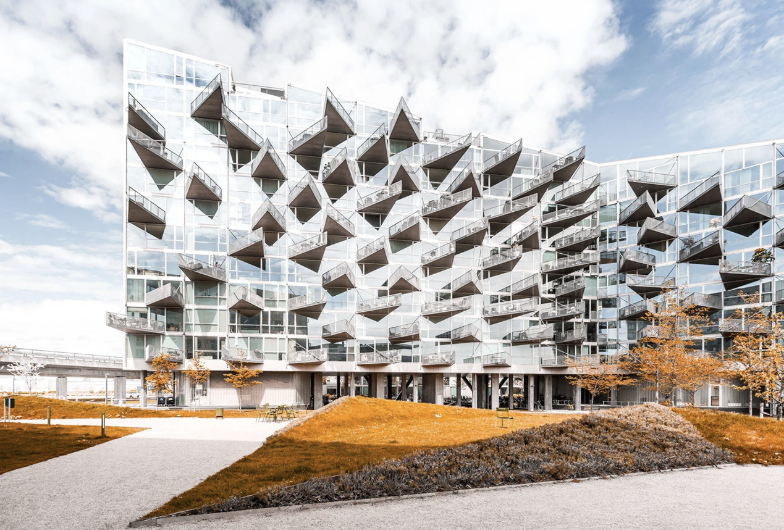
VM Houses rethinks high-density living through daylight optimization and diagonal geometry.
Via 57 West (New York) fuses the American skyscraper with the European courtyard, creating a new urban hybrid Ingels dubbed a “courtscraper.”
4. The Power of Narrative
I guess this doctrine ties back to when I first saw his video explaining a design. At that time I was just getting into architecture, yet he walked us through a narrative design process, questioning this and that, and eventually showing us through sketches how he came up with the final design. This narrative philosophy, that each design must have a concept explained so simply that the public understands. Whether it’s “a ski slope on a power plant” or “a neighborhood as a mountain,” his metaphors invite the public into the architectural imagination.
Case Study: Amager Bakke (CopenHill), Copenhagen
Perhaps my favorite project, sorry if I keep circling back to it. Completed in 2019, CopenHill is the epitome of Ingel's playful design philosophy. Transforming an old waste energy plant to a renewable one with a ski-slope on the roof is the perfect example of Yes is More and his pragmatic playfulness approach.
Program: The plant converts 440,000 tons of waste into clean energy annually, powering 150,000 homes.
Design: Its sloping roof forms a year-round ski slope, hiking trail, and green park.
Technology: The façade’s aluminum bricks are patterned to diffuse sunlight and reduce glare, while an advanced filtration system emits clean air.
CopenHill’s success lies in its dual function — utility and delight. It literalizes Ingels’ belief that architecture should make the world not just more efficient, but more enjoyable.
“We architects have the power to turn pure fiction into physical fact,” Ingels says of the project. “The world needs fewer moral sermons and more examples of fun solutions.”
The BIG Method: Data, Play, and Collaboration
At BiG, architecture begins with research, playful design and ends with a cohesive story. During the tour of their New York office on ArchiTalks, their design lab, which at times operates as a think-tank, is an open one. No principal or one person has the final say, rather everyone, even an intern can have an put on the design. They encourage hands-on playful iterations, often coming with excessive amounts of prototypes during critiques.
Unlike Alvar Alto who uses a lot of physical modeling, BiG echoes Foster and Partners with its use of digital tools. BiG Uses parametric design more than most practices, VR visualization tools and AI simulations to test varying design experiments in the design process. Yet, despite this technology, they remain rooted towards movement, curiosity and playfulness.
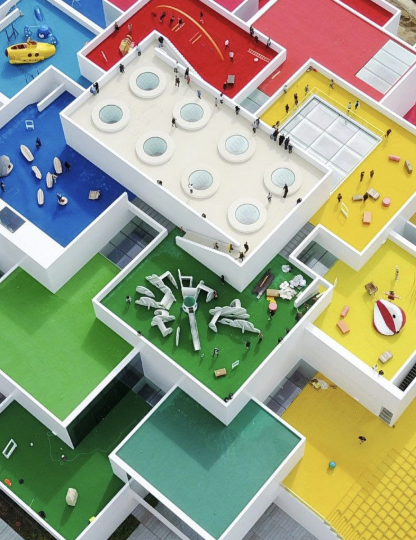
While BiG has expanded globally with works in Shenzhen, New York and London, Ingels continues to emphasize contextual study in his projects. For example his Lego House and Tirpitz Museum are centered around the landscape and culture of the site. In Lego House, he emphasizes Danish heritage in the brand, but also playful imaginativeness of Lego, while Tirpitz Museum seems to become sand dunes, merging history and geology into one cohesive narrative. Even in megaprojects like Google’s Bay View Campus (with Thomas Heatherwick), the emphasis remains on human scale and ecological flow — flexible workspaces under translucent canopies that harvest energy and daylight.
Conclusion: The Joy of the Possible
Bjarke Ingels is perhaps the most playful architect there is today. His buildings embody a belief that architecture can be both visionary and practical, both technological and emotional. Like a 21st-century synthesis of Buckminster Fuller’s optimism and Rem Koolhaas’s realism, Ingels crafts a new kind of architecture, one filled with optimism, joy and imaginative speculation.
“The world is changing,” he says. “Our job is to give form to that change — not as dystopia or utopia, but as something excitingly human.”
